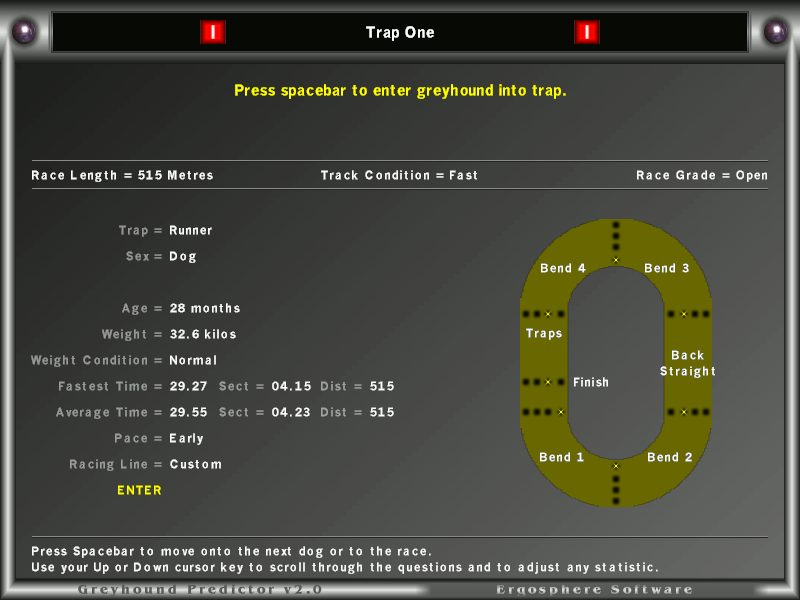
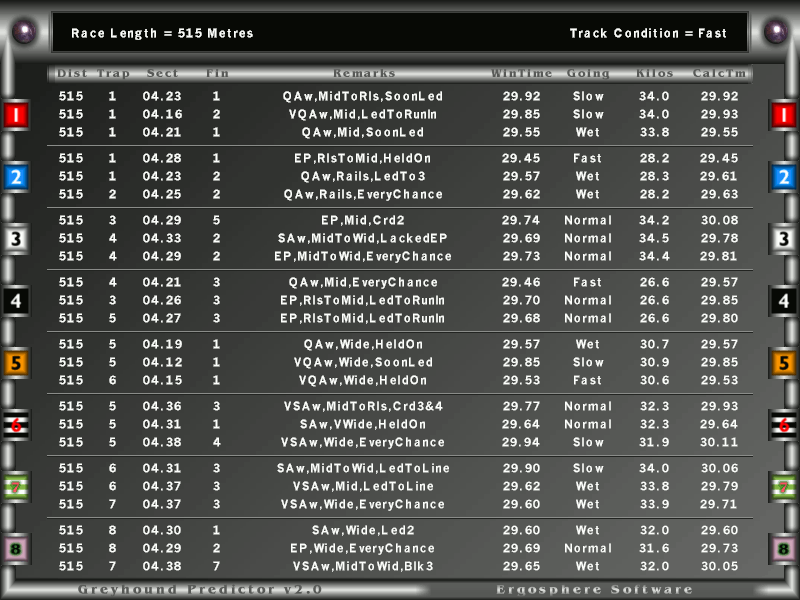
In this section, I explain how to determine the racing pace of a greyhound and discuss the advantages and disadvantages of individual racing styles. Studying Sectional Times, Reading Race Comments, Observing Track Positions and American Chart Writers are included.
Greyhound Predictor Software Version 2.0 allows four types of pace to be simulated:
All dogs will have their own individual style of racing, this is best illustrated by observing a greyhound's pace in a race!
Early Pace - This type of racing pace produces exceptionaly quick sectional times, as these greys reach their top speeds in the early stages of a race. These 'fast breakers' perform best when allowed to dictate a race by leading "on the bunny" all the way from the start and therefore rely on gaining a clear run to set an unassailable lead! However, 'early pacers' inevitably tire and may fade dramatically in the closing stages!
Middle Pace - Dogs with this type of running style are seen to best effect when accelerating along the backstraights in the middle-stages of a race. Although, these 'middle pacers' often find themselves closely surrounded by other dogs racing in a tightly packed field and for this reason are more prone to interference than other pace types and maybe impeded or forced to check when challenging at the 1st or 3rd bends!
Finishing Pace - These 'staying types' show their best running when making ground towards the latter stages of a race and usually benefit when trouble occurs up-front amongst the leaders! However, 'finishers' have to pass all the runners in-front of them and will often be hampered or forced to run wide! Most 'puppies' running-on late in races will in time be stepped-up in distance, as will most dogs better suited to longer staying-trips.
All Round Pace - These hounds generally maintain a 'strong gallop' throughout a race. Although, sometimes it's considered a little one paced!
Now check your raceform.
In order to know a greyhound's pace type, you must literally read between the racing form-lines, as there is no specific statistic that informs you. However, clues are given and basically there are three ways to calculate a dog's pace type:
1 - Studying Sectional Times - You should always try to compare 'sectional timings' run on the same day over the same track distance as this will generally determine which greyhounds are fast, average or slow away in the first few seconds of a race.
In Australia, some of the world's finest stadiums or 'city tracks' supply 3 split times: the initial run to the bend, the approximate 1/2 way clockings and the 'coming home' or 'home run' sectional measured to an accuracy of a 1000 / second taken from the top of the back-stretch to the winning line are stated.
2 - Reading Race Remarks - The following race comments indicate pace-type:
Early Pace = (EP), clear 1st, led 1, very quick away (VQAw), fast away (FAw) always led (ALd), led to line (Ld To Ln), soon clear (Sn Clear), box to wire.
Middle Pace = led 1, led 2 to run-in, led 3, slow away-early pace (SA EP), baulked 1 (Blk 1), crowded 3 (Crd 3), mid-stretch drive.
Finishing Pace = very slow away (VSA), lacked early pace (LEP), led 4, led line (LD Ln), ran on (Ran On), finished well (Fw), stretch drive, winning drive. Some 'LEP dogs' break quickly out the traps but slow into the bend and will be shuffled back in the field before staying-on strongly in the latter stages.
All Round Pace = These greyhounds share similar race comments to other pace types and can win races by both leading from the start or by finishing fast at the end and overall perhaps perform best when holding a good early position!
In Irish greyhound form they use the term evenly away (ev aw).
3 - Observing Race Positions - In UK and Ireland all formlines of previous race positions are recorded at the 1st, 2nd, 3rd, 4th bends and finishing line. This data is located next to the 'sectionals' and generally provides an accurate guide to a dog's pace type:
eg: Early Pace = 1 1 1 1 2 - Middle Pace = 3 2 1 1 2 - Finishing Pace = 6 6 4 3 2 - All Round Pace = 2 2 2 2 2
Generally, it's easy to pick out the 'early pacers' and 'finishers' although dogs that have 'middle' or 'all round pace' will always be a little more difficult!
In American dog racing it's the 'Official Chart Writers' who determine each runners position in a race:
Off Call or Break Call - This is the racing positions of the greyhounds 1 - 8 exiting the starting boxes.
The 1/8 Call - This is the dogs position exiting the 1st (escape) turn.
Stretch Call - This is the runners position in the field measured at a point just entering the final turn.
Finish Call - This is the greyhound's final finishing position 1 - 8 measured at the winning line.
I suggest the 3rd thing to do at a meeting, is to "go out for a shout" and take a look at the runners on parade. I like to see 'alert dogs' with their tail tucked well underneath themselves, resembling a coiled spring, rather than perhaps a 'sluggish looking' or 'happy dog' with its tail waggling in the air!
I suggest the 4th and last thing all 'Greyhound Predictors' should remember to do when going to the "bow wows" or "cherryhogs" is to keep watching the dogs run to the 'pick-up' or 'sough' (sgh) after the race finishes, as this will help identify the correct greyhound pace for all your future predictions!
Now enter Early, Middle, Finishing or All Round Pace.
Next Page: Racing Line