In this section, I explain how variations in a dog's weight affect performances and give my reasons for collecting greyhound programmes.
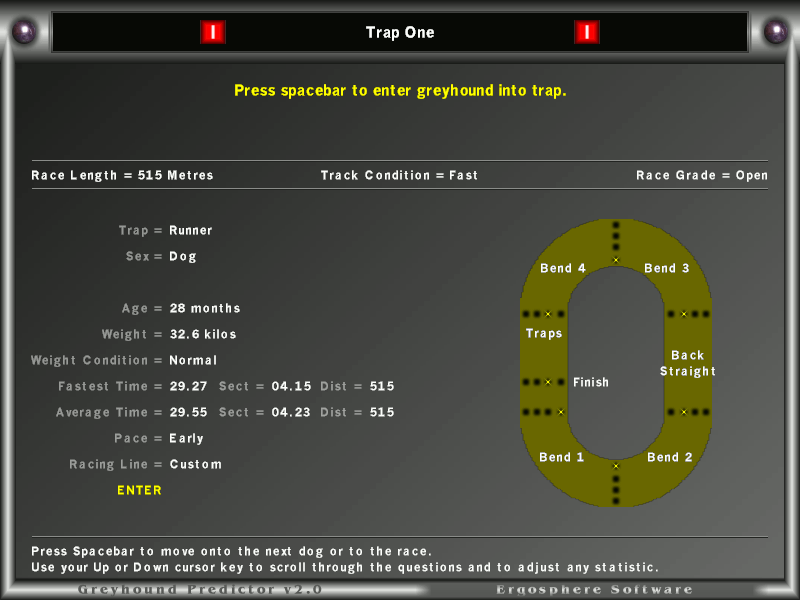
Greyhound Predictor v2.0 requires all dog racing weights to be entered in either Kilos (Kgs) or Pounds (Lbs). All weight conditions can be simulated!
All Australian, European, New Zealand and United Kingdom greyhounds are weighed in Kilograms. American and Irish dogs in pounds.
Dogs weigh on average between 28 - 36 Kilos = 62 - 80 Lbs. and stand 71-76 cms tall. They generally show great determination and bravery when racing to the huge pleasure of their connections and the vast crowds that watch. However, a few of these male racing dogs consistently find trouble in races and may be considered a little awkward or even clumsy! Some of these 'long striding dogs' can weigh in excess of 40kg = 88lbs and are perhaps better suited to racing on wider galloping tracks with bigger circumferences. Although, they do have an advantage over bitches when race conditions underfoot become wet or sloppy as they take less strides to run a circuit!
Bitches on the other hand, weigh on average between 22 - 31 Kilos = 48 - 68 Lbs. and stand approx 68 - 71 cms tall. They protect and look after themselves a little more then dogs and often display 'good trackcraft', as being smaller they can squeeze through racing gaps that larger dogs wouldn't dare to go and also have the advantage of sometimes being able to 'slip under the grill' a little quicker than dogs when initially breaking from the traps!
All runners and reserves for races are put on the scales and weighed prior to racing. British dogs with a weight variation above or below 1kg or 2.2 Lbs (Australia 1 kg, New Zealand 4% of rounded weight, European ?, American racing 2 Lbs, Irish 2 Lbs for dogs weighing up to 60 Lbs, 3 Lbs for dogs weighing 60 Lbs - 80 Lbs and 4 Lbs for dogs over 80 Lbs) from its last trial or start weight will not be permitted to run under normal greyhound rules!
Knowing a greyhound's weight is extremely important as it allows you to determine a dog's racing condition by comparing weights from race to race. However, finding out a dog's weight may often prove difficult as the only way of knowing is to visit your local track!
I suggest, that the 2nd thing you should always do while attending a meeting, is to check the 'weight sheet' displayed at your local dog stadium or park! This is a big advantage in selecting winners given to all 'trackside punters' and a major reason why so many people love going to the dogs!
Recent advancements in online technology now afford 'off track punters' with up-to-date racing weight information supplied by various dog-tracks. Although, many will still not know the previous weights to compare them, a few of us 'anoraks' simply refer back to our more recent old programmes!
If the racing weight of a greyhound isn't known, simply enter your own approximate weight to continue or alternatively leave them blank = 00.0 kg or Lbs. GreyhoundPredictor v2.0 will then set this runner an average weight dependent on its gender!
Now enter the weight in kilos or Lbs.
All greyhounds have their 'optimum weight' known only perhaps to the trainer and maybe the owners! When a dog weighs close to its perfect weight, this implies they are fully tuned-up and ready to produce their fastest times. This is best observed by studying a dog's previous weight variations:
Any greyhound thought 'down in weight' is generally a good positive sign! As losing weight suggests they will race fitter having been well exercised. Personally, I believe these dogs produce fractionally slower than normal sectionals, but compensate by having a little more stamina at the end of a race.
Some greyhounds when first kennelled before racing will be prone to 'kennel fretting' and may become nervous or over excited and may for these reasons lose weight rapidly before finally being placed into the starting traps. This is alternatively considered a negative sign! as it suggests perhaps a weakness in the temperament of the dog, which often results in greyhounds running inconsistently - missed breaks, early faders etc.
Any puppies running with an under-weight racing condition is sometimes also considered a negative sign!
When there is little or no difference between current or previous racing-weights, then select 'normal weight condition'. This is considered a good sign! as the consistency of weight always indicates to the general well being of the dog!
However, any dog previously thought 'down in weight' and was racing at that weight again, should still perhaps be considered 'under weight' even though its weight remains the same! Just as a dog thought 'over weight' and remaining at that weight for it's next race, may still be considered 'up in weight'!
Most 'canines' returning from a 'lay off' maybe over-weight, which is always thought a negative sign! as it suggests they haven't been exercised enough. Personally, I consider these dogs to be initially stronger and genuinely believe 'up in weight' dogs produce fractionally faster than normal sectionals. Although overall, they 'tend to fade' a little sooner then they would normally do in the latter stages of a race!
Handlers I believe, may occasionally elect to put weight on a greyhound in order to help a dog trap out faster, giving them perhaps a better chance to lead up or lie handy with the pace in order to avoid possible trouble anticipated at the corner!
All Pups up in weight is alternatively considered a good sign! as it suggests they're still growing and therefore open to further improvement!
If a dog's weight condition is unknown then simply select Not Known.
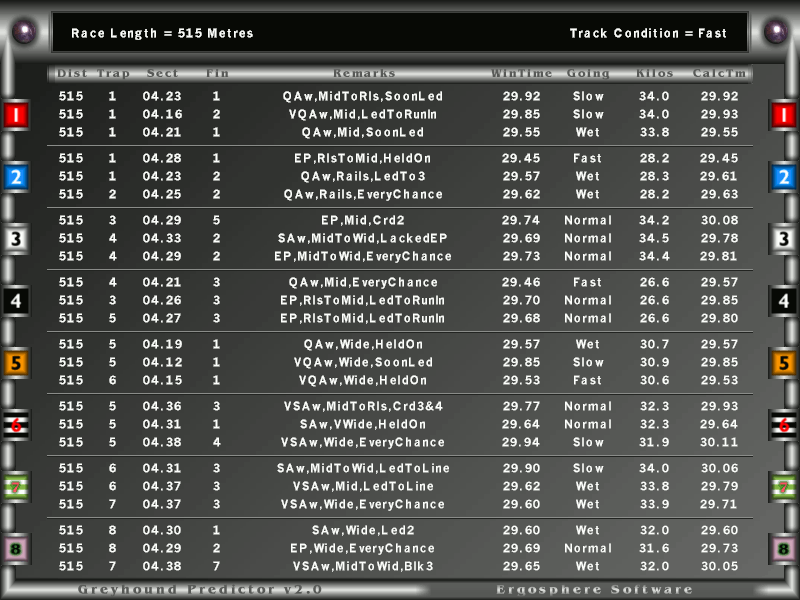
Knowing the weight is afforded to 'trackside punters' who simply compare differences if any, against previous weights displayed in greyhound racecards. When weighing up the form of a race, the one vital factor besides perhaps the times, the age, the going and the draw, that allows me most to determine which dogs to include in bets and combinations, should in theory always be decided by the greyhounds with the best weight condition!
However, dog racing weights can be very misleading! lets imagine that Lady Flyaway has a perfect weight = 27.0 kg and having previously competed at a weight = 28.0 kg, we find that the Lady's running tonight at a weight = 27.6 kg. Would you consider her to be under weight or perhaps over weight? Here lies the general confusion as to why weights are so often misunderstood! In the above example, Lady Flyaway weighing 27.6 kg is in fact 0.6 kg over weight, as we knew her best weight = 27.0 kg. Although, had we thought her ideal weight = 28.0 kg then I would consider her 0.4 kg under weight!
All 'Punters' will appreciate that dogs 'up in weight' can still be 'under weight' and dogs 'down in weight' can still be 'over weight'! Most of us already know that dogs are generally heavier then bitches, although knowing the exact weight is of little use unless you're able to compare these 'weight differences' to determine a dog's true weight condition. This ability to study weights, combined with an accurate estimation of their 'optimum weight' is vitally important, as any change in weight affects performances and therefore plays a significant role in obtaining accurate dog racing predictions!
It is only by collecting these Official Race Programmes or studying online can serious 'racing-students' compare weight variations displayed further back in the formlines and is why so many of us like to collect dog race programmes? Please don't throw them away so many collections sadly go to waste! If you happen to find any old greyhound programmes etc PLEASE, instead contact me. All names of contributors to my collection will be mentioned!
Now enter the weight condition - Under, Normal, Over or Not-Known.
Next Page: Race Times