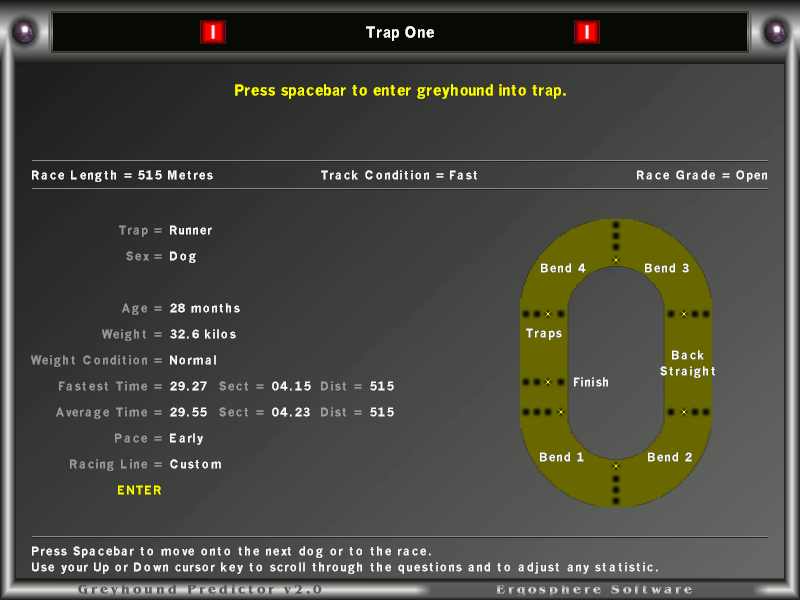
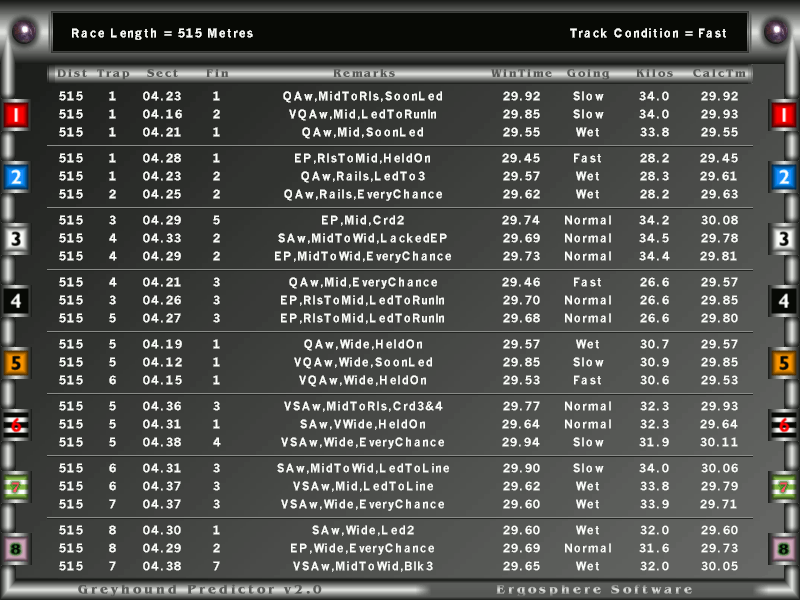
In this section, I explain how different track conditions affect greyhounds with various running styles and why this may alter your future race predictions. Please see: English Track Circumferences, Hare Types and Surfaces. Greyhound Predictor v2.0 Track Dimensions are also provided.
An understanding how the weather affects the surface of a greyhound track is the key to answering this question, the ability to predict accurately in advance the correct going conditions? or state of the track? is indeed a vital element that should always be considered when predicting dog races.
The vast majority of greyhound races worldwide are run on sand, although originally many of todays' prestigious events were first held on grass tracks. Other surfaces used include the 'loam tracks' seen in Australia and not to forget the old 'cinder tracks' of greyhound racing's historical past.
All greyhound establishments will try to maintain a fair and safe circuit for racing by regularly rolling flat and watering the sand. However, this can often be a difficult task to achieve as 'track-surfaces' are constantly affected by adverse weather conditions. Therefore, any dogs fortunate to race on a faster surface then their competitors, theoretically can produce quicker times! This 'advantage' or alternatively considered 'disadvantage' in the bias of the track is very significant as it not only affects results but also influences any betting in a race!
I suggest, the 1st thing all "Predictors" should do while attending a race meeting is to check the condition of the track. This is a major advantage in selecting winners given to all race-goers! Although, there are still three possible ways for 'off track punters' to calculate the correct going conditions. Firstly, by paying attention to local weather forecasts for any 'climatic changes' due to affect the race surface. Secondly, you may notice a repetitive pattern to 'previous trends' of winning trap numbers reflected in past results. Or thirdly, by studying the 'win times', 'racing lines' and 'running styles' of all the winners from earlier races, then decide if it's the inside, middle or outside traps if any, that has the advantage on those particular surface conditions.
Greyhound Predictor Software allows you to simulate four race conditions:
Fast Track - [+0.40 secs = GP state of going adjustment] - All greyhounds racing in hot sunny atmospheric temperatures can produce very quick times, as these race conditions generally favour the 'inside runners'. It is usually on 'faster ground' in the summer months that track records maybe broken, although a hard frozen track in mid-winter may also be considered to be running fast and overall benefits the 'quick away runners'!
Normal Track - [0.00 secs] - Dogs racing on a normal surface should produce normal race and sectional times. This type of going should always be considered fair to all racing lines and running styles of greyhounds.
Slow Track - [-0.40 secs] - Winter racing in cold temperatures on wet, windy, sloppy tracks will produce slower times and overall favours the 'finishers'. The races being slower run than normal inevitably gives the 'stayers' more time to get into a virtual dog race!
Wet Track - [+0.20 secs] - A recent shower of rain generally makes a track run a little faster than normal, although heavy persistent rainfall invariably slows speeds down and favours the 'middle to outside runners'. The inside surface often becomes waterlogged due to the natural contours of a track, therefore dogs coursing a middle, wide and even sometimes an extremely wide raceline, frequently have the advantage of running on a faster surface!
One type of weather condition besides perhaps heavy snow or frozen ice that may occasionally lead to a meeting being abandoned is that of thick fog, as it will be deemed too dangerous to race, once the 'hare controller' has lost sight of the lure and its distance to the leading dog.
As all 'Punters' will know, race conditions affect results and therefore play a vital role in understanding 'The Science of Greyhound Race Prediction!'
Now enter the track condition - Fast, Normal, Slow or Wet
Next Page: Race Length