In this section, I mention famous greyhound races held in Great Britain & Ireland and their associated venues. I include information on race speeds, classic winners and affiliated trainers and compare English dog racing grades with Irish, American and Australian grading systems.
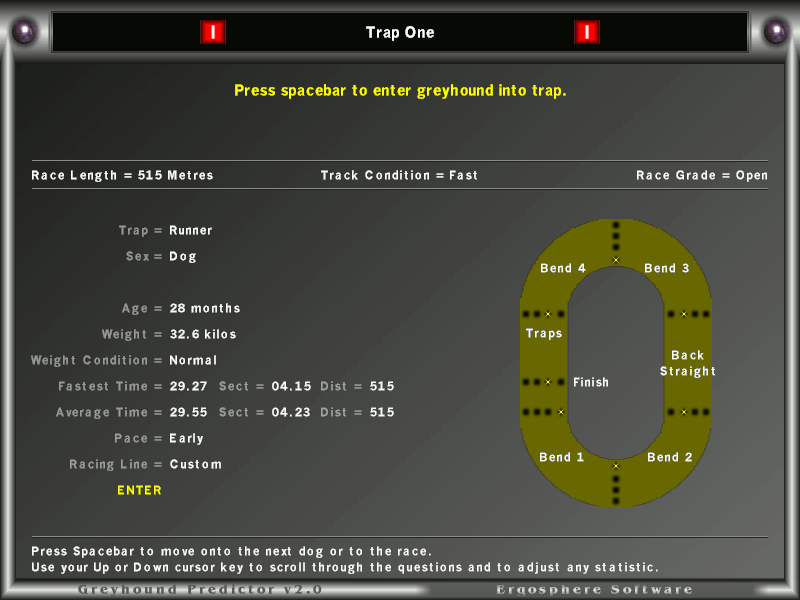
Greyhound Predictor Software v2.0 allows you to simulate four race grades: Open Race, Top Grade, Middle Grade and Low Grade.
In England an 'open race' represents the highest standard of racing grades and consists of two divisions - Major Open Races - Category One (OR1), Two (OR2), Three (OR3) & Minor Opens (OR). In Ireland the best middle-distance races are called AAO's. In America these races are known as RSA's or SA's (Racing Secretaries A Class). In Australia all major competitions are classified as Group Races and generally referred to as FFA's (Free for All).
Out of all the 'classic races' held annually, the English Greyhound Derby - won 14/06/25 by Droopys Plunge trained by Patrick Janssens - (Towcester) originally staged in 1927 at the White City Stadium, London, still remains today the most important competition. This year's derby sponsored again by Star*Sports & TRC Health & Leisure carried a winner's purse of £175,000 with a further £50,000 bonus for the victor going on to win the Irish Derby!
Other 'national derbies' include the Scottish Derby first held at Carntyne, Glasgow in 1928 - last won 04/05/19 by Braveheart Bobby trained by Pat Buckley IRE - (Shawfield - Closed). Famous Scottish races included the St Mungo Cup and Edinburgh Cup previously staged at Powderhall Stadium. The Welsh Derby run from 1928 - 1937 at White City, Cardiff and from 1945 - 1977 at Cardiff Arms Park, will now be held at the 'Valley' Ystrad Mynach. The Trigo Cup known as Ulster Derby, first held at Celtic Park, Belfast in 1929 was reinaugerated in 2010 as the Northern Irish Derby - (Drumbo Park).
Along with the derby, the English Oaks - won 26/10/24 by Druids Say Go trained at Towcester by Patrick Janssens - (Perry Barr) a race confined to bitches first run at White City in 1927 are the oldest classics. This event sponsored by Premier Greyhound Racing (PGR) carried a first prize of £20,000.
The St Leger previously run from 1928-1998 at Wembley's 'Empire Stadium' is the oldest 'stayers classic' - won historically again 28/09/24 by "2023 GBGB stayer & PGR greyhound of the year" Droopys Clue trained at Brighton & Hove by Seamus Cahill - (Perry Barr) with a winner's prize of £20,000.
Other famous races include: All England Cup - (Newcastle), Essex Vase, Golden Sprint, Coronation Cup and Champion Stakes - (Romford), Brighton Belle, Gold Collar, Sussex Cup, Regency and Olympic - (Brighton & Hove), Kent Derby and Kent St Leger - (Central Park), Gold Cup - (Harlow), Premier Greyhound Racing Golden Jacket, Gold Cup and Summer Stayers Classic - (Monmore Green), Pall Mall and Hunt Cup - (Oxford), Laurels, Scurry Gold Cup and Birmingham Cup - (Perry Barr), PGR Eclipse - (Nottingham), Steel City Cup and 3 Steps To Victory - (Sheffield), ARC Classic and Grand Prix - (Sunderland), KAB Maiden Derby - (Towcester), 79th East Anglian Derby - (Yarmouth) etc.
Long-distance races include: The Cesarewitch first run in 1928 - won 22/01/25 by Garfiney Blaze trained by Mark Wallis (Unattached) - (Central Park), The Television Trophy first inaugerated by the B.B.C. in 1958 - won 23/03/25 by Mongys Wild trained by Mark Wallis (Unattached) - (Towcester), Dorando Marathon - won 14/06/25 by Alright Patricia trained at Oxford by David Lewis - (Towcester), and Boxing Day Marathon - won 26/12/24 by Turbine Tilly trained at Central Park by Daniel Brabon - (Crayford - track closed 21/01/25).
Puppy races include: English Puppy Derby, bet365 English Puppy Oaks and Juvenile Classic - (Towcester), 78th BGBF Produce Stakes - (Swindon), Coral Puppy Cup - (Romford), The Northern Puppy Derby - (Newcastle), Coral Sussex Puppy Trophy and Hove Puppy Cup - (Brighton & Hove), Gymcrack Puppy Championship and BGBF British Bred Derby - (Sheffield), British Breeders Stakes and Jenningsbet Puppy Classic - (Nottingham), Puppy Derby - (Monmore Green), Puppy Cup and Cowley Puppy Collar - (Oxford), Future Stars Puppy Trophy and ARC Puppy Cup - (Sunderland) etc.
The 2024 English Trainers' Title was won for a record 15th time by "champion trainer" Mark Wallis based at the Imperial Kennels, Lakenheath, Suffolk.
Only the top six handlers or reserves qualify for the PGR "Judgement Night" Trainers' Championship held 29/03/25 at Perry Barr - won by Mark Wallis. Selected winners included: Dash 275m - Fire And Ice (N Hunt), Puppy 480m - Deliverooo (Tom Heilbron), 480m Bitches - Southfield Poppy (K Hutton), 480m Standard A - Romeo Steel (Patrick Janssens), 480m B - Clona Dash (T Heilbron) and Stayers 660m - Droopys Flotilla (Nathan Hunt).
Other Invitational races (IV) include the Time Juvenile and Derby Invitation - (Towcester), The Select Stakes and The Select Stayers - (Nottingham), EAD Invitation and YGTOA Invitation Marathon - (Yarmouth) and the odd Showdown - "swan vesta" Match Race (M) sometimes limited to only two dogs.
Famous races include: British Bred St Leger, Plate, Silver Salver - (CPark), Peter Bussey Memorial, Guys & Dolls and Kent Cesarewitch - (Crayford), Yorkshire Derby and BGBF St Leger - (Doncaster), Ladbrokes Winter Derby - (Monmore Green), British Bred Oaks & bet365 Challenge Cup - (Oxford), Angel Of The North and Northern Flat - (Newcastle), Midlands Sprint - (Nottingham), Doug Tyler Summer Cup, Mitch Milward Marathon and Rosebowl - (Romford), Queen Mother Memorial Cup - (Sheffield), Blue Riband, Northamptonshire Sprint, Jack Murrell Memorial Trophy, The Empress Stakes, Champion Bitch Stake and Greyhound Stud Book Trophy - (Towcester), Derby Purse, Grand Final and East Anglian Challenge - (Yarmouth) etc.
Minor Opens (OR) include 'one-offs' with a minimum £100 to the winner. Maiden Opens are limited to dogs yet to win an Open Race over the distance.
As from 31st March 2014 the Irish Greyhound Board (IGB) has implemented new race grading bands. For 525 yard races all dogs recording a time less then 28.49 secs will be classed as AAO, 28.50s - 28.69s = AO, 28.70s - 28.89 = A1, 28.90s - 29.19s = A2 up to and including 30.50s - 30.70s = A10. Please See IGB RACE GRADE BANDS for further information.
The BoyleSports Irish Derby - won 23/11/24 by Bockos Diamond trained by Graham Holland - (Shelbourne Park) first run in 1932 is the most prestigious event in the racing calendar with a winner's purse of €125,000. Although, originally preceeded by the 'National Derby'first held at Harolds Cross in 1928.
Other famous Irish races include: The Gold Cup - won 22/02/25 by Seven Beach (Jennifer O'Donnell), Easter Cup first staged in 1928 - won 05/04/25 by Hopes Teddy (Pat Buckley), Irish Oaks - won 15/06/24 by Fleadh Saraide (Murt Leahy) & A Lucky Julie (Jimmy Melia) and Champion Stakes - won 06/07/24 by Daleroad Duke (Patrick Guilfoyle) - (Shelbourne Park - SPK). Limerick Oaks - won 08/03/25 by Barefoot On Song (Paul Hennessy), Irish St Leger first run at Celtic Park, Belfast in 1932 - won again 17/08/24 by Clonbrien Treaty (G Holland), Cambridgeshire won 14/09/24 by Tuono Charlie (Sharon Hunt) - (Limerick - LMK). Cork Oaks - won 22/03/25 by Silverhill Freya (Graham Holland) and Irish Laurels - won 05/10/24 by Crafty Shivoo (Pat Kiely) - (Curraheen Park - CRK). National Produce Stakes - won 01/06/25 by Lemon Joey (Murt Leahy) - (Clonmel - CML). Irish Sprint Cup - won 15/08/24 by Broadstrand Syd (John Linehan) - (Dundalk - DLK). Galway Oaks - won 25/10/24 by Drombeg Pearl (Evan McAuliffe) - (Galway - GLY), Future Champion & Michael Fortune Memorial - won 07/04/25 by Unattached (Eddie Dobbs) - (Enniscorthy - ECY). Newbridge Derby - (Newbridge - NWB). Cesarewitch - won 09/03/25 by Singalong Dolly (Pat Buckley) & Fair Warrior - won 27/10/24 by Born Racer (J O'Donnell) - (Mullingar - MGR). Race Of Champions - won 14/06/24 by Coolavanny Otto (Pat Buckley), Juvenile Derby - won 08/03/24 by Ballymac Patriot (Liam Dowling) and Kingdom Derby - won 27/12/24 by Ballymac Briar (L Dowling) - (Tralee - TRL). Munster Oaks - won 07/09/24 by Hello Rose (G Holland) - (Waterford - WFD).
Famous greyhound Invitational races include: The TIME Select Stakes - won 27/04/24 by Droopys Fidget trained by Robert Gleeson - (Waterford), Dundalk International - won 12/07/24 by Droopys Mandolin (R Gleeson) - (Dundalk). There's also occasional Irish-Anglo challenges - (Shelbourne Park). Throughout the year 'festivals of racing' take place at Clonmel, Cork, Dublin, Enniscorthy, Galway, Kilkenny, Lifford, Limerick, Tralee etc.
Shelbourne Park hosted their 4th annual Winter Racing Festival gala meetings held 06/12/24 & 07/12/24. Selected winners included: WRF Sprint 350 - Road Exile (Pat Buckley), WRF Juvenile 525 - Cheque For Cash (Karol Ramsbottom), IGOBF National Puppy Stake - Untold Ruffiyaa (David Byrne), Winter Racing Festival Championship Bitch 525 - Is She There (Rosemary Price), WRF Championship 525 - The Other Kobe (Graham Holland), WRF Bitch 550 - Grangeclare Lady (Owen McKenna), WRF 550 - Faypoint Harvey (G Holland), WRF Championship 550 - De Lahdedah (Liam Dowling), WRF Championship 575 - Bombay Pat (Graham Holland), WRF Championship 600 - Untold Dollar (Graham Holland), Winter Racing Festival Championship 750 - Jaytee Craze (Paul Hennessy), Winter Festival Stayers 850 - Ballyhooly Teejay (Tom O'Neil).
In Ireland puppies begin their racing careers in Novice grade (N0 - N3) although, some may also compete in open competitions for greyhounds unraced! The most valuable is the Connolly's Red Mills Unraced - (Cork) with a winner's cheque of €16,000. Although, The Con & Annie Kirby Memorial - won 19/04/25 by Faypoint Ranger trained by Graham Holland - (Limerick) with a first prize of €80,000 remains the world's richest puppy race!
The world's fastest greyhounds average speeds around a circuit approaching 40 mph / 64.37 kph! Although, these very 'top speeds' may only be achievable on first class 'galloping tracks' with big circumferences, long racing straights and wide sweeping cambered bends!
The quickest time run over 515 metres is 28.88 secs set 25/01/01 by Australian "wonder dog" Brett Lee trained by Darren McDonald from Peacedale, Victoria in Adelaide Cup held at Angle Park, South Australia (circumference 457 metres) and represents an average speed of 39.89 mph / 64.20 kph!
Interestingly, the fastest time in the UK for 515 metres is 29.20 secs set 31/07/07 by "brilliant Barney" Barnfield On Air trained by Sam Poots (retired) in Sussex Cup run at Brighton & Hove greyhound stadium (circumference 455 metres) representing an average cruising speed of 39.45 mph / 63.49 kph. The best time achieved by a bitch is 29.54 secs set by Bridge Ruth trained by Mark Wallis (38.99 mph / 62.76 kph) when winning 2013 Brighton Belle. Although, this time was equalled 31/08/17 by "2018 bitch of the year" Donation trained by Heather Dimmock in a heat of the 500 Ladies.
The Towcester Racecourse 500 metres record (circumference 442 metres) was recently broken 31/05/25 by Lennies Desire trained in Ireland by Paul Hennessy when setting new figures for the Derby-trip of 28.39 seconds (39.40 mph / 63.40 kph) in a 1st round heat of the PricedUp.Bet Derby Plate.
The 2024 English Greyhound Derby 500 metres record was sensationally equalled by "derby champion" De Lahdedah trained by Liam Dowling based at Ballymacelligott, County Kerry, Ireland when recording 28.58 secs (39.13 mph / 62.98 kph) in StarSports & TRC Derby Final held 29/06/24 matching the previous record set 24/05/24 by King Memphis trained at Central Park by Liz & Rab McNair in Derby 1st round and by "2023 & 2024 St Leger winner" Droopys Clue trained at Hove by Seamus Cahill in Derby Trial Stake held 14/04/24 at Towcester.
The 2019 English Derby held 25/05/19 at Nottingham (circumference 437 metres) over 500m was set alight by Skywalker Logan trained in Ireland by Patrick Guilfoyle when breaking Sawpit Sensation's previous best by eleven spots when recording 29.05 seconds (38.50 mph / 61.96 kph) in 1st round. The fastest time by a bitch was 29.27 secs (38.21 mph / 61.50 kph) set in 1st round heat by "2023 British bred dam of the year" Queen Beyonce. Although, Ballymac Tas trained by Liam Dowling (IRE) became the first bitch since Dilemmas Flight in 2007 to reach the final, finishing runner-up!
The old Greyhound Derby record for 500 metres was 28.72 secs set 09/06/17 by Tyrur Shay trained in Ireland by P J Fahy in 2nd round heat held at the old Towcester track (circumference 426 metres) and represents an average speed of 38.94 mph / 62.67 kph.
The old Derby record for 480 metres - Wimbledon (circumference 414 metres) was broken 30/05/15 by the "2015 British bred greyhound of the year" Eden The Kid trained by Liz McNair when posting 27.95 secs (38.42mph / 61.83 kph) in Derby 1st round heat.
The English National 480 metres distance record was broken 15/09/20 by Roxholme Kristof trained by Hayley Keightley when posting 27.27 secs in the Gain Greyhound Nutrition 3 Steps To Victory 1st round held at Owlerton Stadium, Sheffield (circumference 425 metres) averaging 39.38mph / 63.37 kph.
The Scottish Derby 480 metres record was lowered again by Droopys Buick trained at Newcastle by Jimmy Wright & Angela Harrison when recording 28.55 secs in semi-final held 22/04/17 at Shawfield (circumference 432m). Although, surprisingly the average speed was only 37.61 mph / 60.52 kph!
The 2024 BoyleSports Irish Derby record for 550 yards (503 metres) - Shelbourne Park (circumference 425 yards) was sensationally smashed 02/11/24 by "2024 Irish Derby champion" Bockos Diamond trained in Ireland by Graham Holland when posting a sparkling 28.94 secs (38.87 mph / 62.56 kph) including sectionals of 03.30s and 16.63s in the 3rd round, a record he equalled again in the semi-final including sectionals of 03.27 and 16.57s!
The previous best of 28.99 secs (38.81 mph / 62.46 kph) was set 22/08/20 by Pestana trained by Owen McKenna in the 2020 Irish Derby 2nd round, beating the 29.10s old record held by Tyrur Van Gaal trained by PJ Fahy and also broke the Irish National distance record of 29.07 secs set 22/07/17 at Curraheen Park by Killmacdonagh trained by Kieran Lynch and thus became the first greyhound in history to dip under 29.00 seconds for the derby trip! The fastest time by a bitch is 29.12 secs set 21/07/19 by Ballymac Arminta trained by Liam Dowling in semi-final of the BoyleSports Champion Stakes.
The "2023 BoyleSports Irish derby winner" The Other Kobe trained by Jennifer O'Donnell produced the fastest Derby clocking to the third bend of 16.85 secs and recorded 29.11 secs for the 550 yard trip and is the quickest run in a 'modern-day' final beating Susie Saphire's previous best of 29.18 secs.
The "2021 BoyleSports Irish derby winner" Susie Sapphire trained by Owen McKenna for owner breeder Peter Comerford became the first bitch to win the Derby since Spring Time in 1999 and completed the 'classic double' by winning both the Irish Derby & Oaks in the same year!
The fastest run in Ireland over 525 yards was recently achieved by 'lightly raced bitch' Droopys Kathleen trained in Ireland by Robert Gleeson when recording a sizzling hot 27.58 seconds (38.94 mph / 62.66 kph) in the 2024 Gourmet Island Puppy Oaks semi-final held 09/11/24 at Shelbourne Park. Thus breaking the record of 27.67 secs set by Paradise Madison trained by Oliver Bray in the Comerford Cakes National Puppy Stake held 08/12/12. The quickest 525 sectional time to the 3rd bend is 15.66 secs recorded 17/09/22 by Hawkfield Ozark trained in Ireland by Jamie McGee.
The 525 yards record was once held by Catunda Harry trained by Owen McKenna, who became the first dog to break 28.00 seconds on an Irish track, when recording 27.99 secs in heat of the Ballygodoon Stud Puppy Stakes run 17/06/07 at the old 'Market Fields' track at Limerick.
The Northern Irish 525 record is 27.88s (38.52 mph / 61.99 kph) set by Leeveiw Jet (Graham Holland) in the Tennants Gold Cup - (Drumbo Park - DBP).
In Australia at Capalaba in Brisbane, Upper Class Lad trained by John Catton (Mount Cotton) running in the Michael Miller Memorial Cup (03/10/15) over a straight grass track recorded 19.28 secs for 366m / 400y - averaging 42.46 mph / 68.34 kph and is claimed to be a WORLD RECORD SPEED! Although, speed tests conducted by Towcester Racecourse using a hi-tech transponder system taken from dogs competing in the 2017 English Derby, interestingly revealed split-second acceleration speeds approaching 50 mph / 80.47 kph!
Other standard prefixes that indicate type of race grading include: (H) = Hurdle and (CH) = Chase - two extra hurdles are added.
The first hurdles race in England took place at Belle Vue Stadium, Manchester at its opening meeting held 24th July 1926 - won by Melksham Autocrat.
The most famous race is the Grand National - won 24/11/24 by Signet Harper trained by Ricky Holloway - (Crayford) first run White City, London in 1928.
UK Category 1 hurdle races include: Springbok - won 29/7/23 by Droopys Chaser trained at Romford by Paul Young - (Hove) and Ladbrokes Champion Hurdle - won 21/7/24 by Nunhead Shiv trained at Central Park by Barry O'Sullivan - (Crayford) is the oldest 'hurdle classic' first run at White City in 1927.
Cornamaddy Jumbo trained by Mark Wallis then attached to Yarmouth was voted "2014 hurdler & greyhound of the year" when becoming the first dog to complete the 'English triple crown' by winning all three Cat One Hurdle Events - The Springbok, Grand National and Champion Hurdle in the same year!
Category 2 & 3 events include: The Chief Ramsbottom Hurdle, Golden Jacket Hurdle, Dual Distance Hurdle, Kent National Hurdle, Champion Hurdle Marathon, Kent Champion Hurdle, Kent St Leger Hurdle, Spring, Summer, Autumn Hurdle - (Crayford), Merit Hurdle and Jimmy Jupp Hurdle - (Hove), Roger Kent Barton Triumph Hurdle - (Romford) and Supreme Hurdle - (Towcester) etc.
Occasionally a dog will be given a 'hurdle handslip' and released not from the traps, but 'hand slipped' along the straights in order to gradually introduce them to hurdling. Please note: any runner having competed in a hurdle race or schooling trial and was subsequently switched back to race on the flat, is always considered a good sign, as the hurdles tend to concentrate a dog's mind on its racing and therefore sharpens them up!
In Ireland, Greyhound Racing Ireland (GRI) decided 16/11/21 due to their concerns over certain welfare issues, to discontinue all hurdle races forthwith. The Irish Grand National - won 12/12/20 by Razldazl Annie trained by Neilius O'Connell - (Curraheen Park) was sadly the last classic hurdle race run.
The vast majority of dog races run around the world are known as 'Graded Races' (GR's). Middle-Distance Grades include:
U.K. - Top Grade - (A1 - A3) equivalent to American greyhound grades (A, B) and Australian racing grades (1, 2). Some of the best 'top graders' may also compete in Category One major open events and generally average speeds around a track between 38-39 mph.
U.K. - Middle Grade - (A4 - A6) equivalent to American racing grades (C, D) and Australian grades (3, 3/4, 4). Occasionally, graded runners competing at the very best 'city tracks' maybe the equal of A1 dogs running at lesser not so good 'country tracks' and can average speeds between 37-38 mph.
U.K. - Low Grade - (A7 - A11) equivalent to American grades (E, F and Maidens) and Aussie grades (4/5, 5 and Maidens). Most greyhounds will either start or finish their racing careers in these lower grades and generally record average speeds around a circuit between 35-37 mph.
U.K. - B Grade (B1 - B6) This grade prefix indicates to a slightly shorter or longer standard distance.
Knowing the grade of a race is very important, as it's an approximation to the expected level of performance and indicates to the overall race standard. Generally, I consider a greyhound's grade should reflect past performances and be relative to previously recorded times!
When fully fit 'Graders' tend to run more frequently than 'Open Racers' and usually compete in a race once a week, although twice was not uncommon. However, any dog thought 'over raced' will generally see a decline in racing form and may need a rest to freshen them up! In 2018 The Greyhound Board of Great Britain (GBGB) launched their new Greyhound Commitment strategy dedicated to improving the safety, welfare and lives of greyhounds: Rule 147 now states that a dog will only be allowed to race once over a 4-day period with a maximum of 6 races or trials in any 28-day period.
Puppy and Veteran / Senior races are represented by a standard prefix: (P) = Puppy and (V) = Veteran.
Other types of racing grades that may take place include: (KC) = Kennel Championships, (KS) = Kennel Sweepstakes, (IT) = Intertrack Racing, (Hcp) = Handicap Racing and the previously held but now outlawed (QS) = Quickstakes - 2 or 3 semi-finals take place with the final run at the same meeting.
All 'Punters' when studying graded greyhound form will always face the dilemma of not knowing whether to back a good dog 'lowered in class' running badly or a not so good dog 'raised in class' running well? "If only I had a crystal ball" I hear you say!
Successfully predicting Graded Races (GR's) will invariably be more challenging than forecasting Open Races (OR), as the 'grader' generally grades the races very closely with only minute differences in time to choose between the runners.
To obtain the best results from the 'Predictor' I therefore suggest choosing UK OR's, Irish AAO's, American SA's or Australian FFA's, as the runners in these top geyhound grades are not only more consistent, but also allow "canine superstars" to compete with much greater differences in racing ability. This is most noticeable during the early rounds of major competitions and theoretically makes the 'open grade' more predictable than a graded race. Although, these differences in the dog's standards will always no doubt be reflected in the individual prices quoted as the odds of a greyhound race!
For all 'Greyhound Predictors' wishing to simulate dogs 'raised or lowered' in grade, then one of the best ways to represent a change in race-grade would be to alter a dog's time! For example, if you consider a greyhound to be 'upped in class' then you should perhaps add-on between 0.10 - 0.20 seconds to their fastest time, as up-graded dogs theoretically, are less likely to obtain a trouble free run in-order to produce their very quickest times. Although, often to the contrary, certain strong 'improving greyhounds' may actually appreciate a quicker overall travelling speed throughout a race and will be towed along in the 'faster slipstreams' of other initially speedier dogs and despite being 'raised in class' will continue to improve their best times. For further information please see Racetimes.
Alternatively, if you wanted to simulate down-graded dogs then you should perhaps deduct between 0.10 - 0.20 seconds from their fastest time, as all dogs 'lowered in class' theoretically, have a better chance of being afforded more 'racing room' in a lower graded race to improve on their quickest times, and indeed yes, you may deduct an appropriate amount of time that best simulates greyhounds dropped in grade.
I should also like to mention in the interests of 'The Science of Greyhound Race Prediction' that since the dogs themselves remain completely unaware of the racing grade their running in or have previously competed at, then you may wish to leave a dog's fastest time as it is, the choice is always yours!
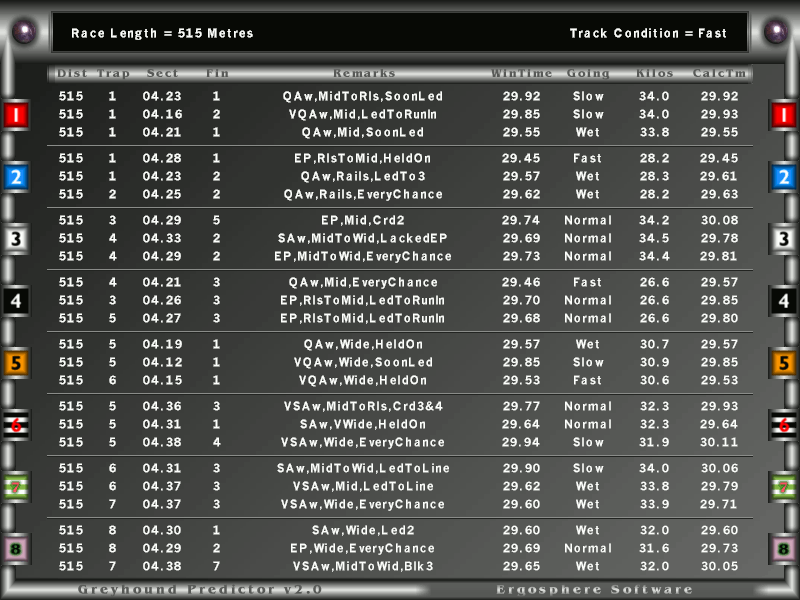
Now check the formlines, the stat grade of race is found at the top of each race heading.
Now select the correct grade category and Press Spacebar to enter.
Next Page: Track Condition